


 PLATFORM UPDATE:


Hierarchical micro-tile growth of monoclinic tungsten oxide nucleated on MWCNTs hexagonal skeletons: wide-potential solid-state supercapacitor with a mechanical bendable design

Abstract
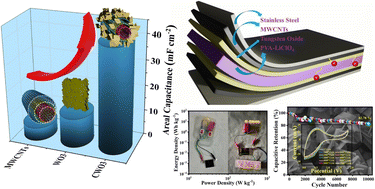
Material mutualism in the growth process has facilitated the formation of monoclinic tungsten oxide (W25O73) on hexagonal multi-walled carbon nanotubes (MWCNTs), which act as self-sacrificing templates to produce a controlled micro-tile surface architecture through a simple chemical route. The monoclinic crystal structure of tungsten oxide (W25O73) was confirmed by using X-ray diffraction and high-resolution transmission electron microscopy. The three-electrode electrochemical analysis of the MWCNTs/W25O73 film revealed a high specific capacitance of 1301.46 F g−1 (areal capacitance = 273.31 mF cm−2) at a scan rate of 1 mV s−1 with a potential window of 0.94 V in 1 M LiClO4. The designed flexible symmetric solid-state supercapacitor device displayed a remarkable voltage window of 1.86 V aided by Li+ ions embedded in the polyvinyl alcohol polymer matrix with a specific capacitance of 259.24 F g−1 (areal capacitance = 54.44 mF cm−2) at 5 mV s−1 scan rate. Even after 10 000 consecutive cycles, the device preserved 82.78% of its initial capacitance, confirming reliable long-term operational stability. An in-depth examination was conducted using power law calculations, diffusion and capacitive contributions, and electrochemical impedance spectroscopy analysis. The device exhibited an excellent mechanical flexibility of 99.62% at a bending angle of 170° along with practical viability in powering a small DC fan and LED panel, showcasing its potential for future advanced applications.
- This article is part of the themed collection: Supercapacitors for a sustainable energy future
 Please wait while we load your content...


