


 PLATFORM UPDATE:


Promoting effect of Cu2+ ions on electrochemical ammonia oxidation using CuO electrocatalysts
 †a
Hyun Ji
An,
†a
Jiwon
Jeon,
†b
Eunchong
Lee,
a
Sang Heon
Han,
a
Hyeyoung
Shin
*b
and
Yun Jeong
Hwang
*a
†a
Hyun Ji
An,
†a
Jiwon
Jeon,
†b
Eunchong
Lee,
a
Sang Heon
Han,
a
Hyeyoung
Shin
*b
and
Yun Jeong
Hwang
*a
Abstract
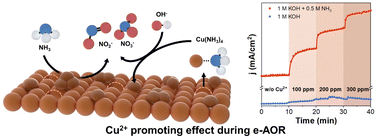
The electrochemical ammonia oxidation reaction (eAOR) has attracted significant interest because of its utility for the hydrogen–ammonia economy. Here, we demonstrate that CuO can be a stable and active electrocatalyst for the eAOR via the dynamic cycle of Cu2+ ions. Although metal ions readily dissolve under eAOR conditions, their promoting effect has not been developed. In situ ultraviolet-visible spectroscopy analyses, along with density functional theory simulations, indicate that dissolved Cu2+ ions form [Cu(NH3)4]2+ complexes, which preferentially adsorb on the CuO catalyst compared to free NH3 and serve as crucial active species initiating eAOR on the CuO surface. Additionally, when the chelating reagent inhibited the formation of [Cu(NH3)4]2+, both the eAOR catalyzed by the CuO catalyst and the deposition of Cu2+ ions were suppressed, indicating that [Cu(NH3)4]2+ is a crucial species for the activity and stability of the CuO catalyst. This study provides a new perspective on the role of Cu2+ ions and highlights the significance of their interaction with ammonia, deepening the understanding of improved electrocatalyst systems for the eAOR.
 Please wait while we load your content...


