


 PLATFORM UPDATE:


Dynamic origins of cation-modulated stability in tin-based perovskites revealed through combined fine-tuned machine learning interatomic potentials and experiments

Abstract
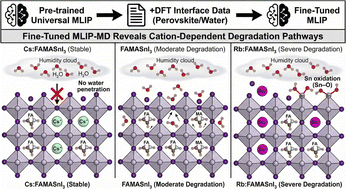
Tin-based halide perovskites are promising lead-free photovoltaic materials, but their poor stability in moisture hinders commercialization. While A-site cation engineering is a key strategy to enhance durability, the underlying mechanisms are not well understood. This work combines experiments with fine-tuned machine learning interatomic potential molecular dynamics (MLIP-MD) simulations to unravel the role of Cs+ and Rb+ cations in the degradation of FA0.75MA0.25SnI3 (FAMASnI3). Our experiments establish a clear stability trend: Cs0.125FA0.75MA0.25SnI3 (Cs:FAMASnI3) > FAMASnI3 > Rb0.125FA0.75MA0.25SnI3 (Rb:FAMASnI3). Long-timescale simulations reveal distinct degradation pathways at the perovskite/water interface. For pristine FAMASnI3, degradation is dominated by physical processes like water infiltration and surface cation dissolution. In contrast, Cs doping effectively inhibits water penetration and maintains structural integrity, ensuring superior stability. The instability in the Rb-doped system follows a destructive chemical path: significant Rb+ displacement triggers iodide detachment, exposing reactive Sn sites. This leads to Sn–O bond formation and subsequent Sn oxidation, identified as the primary failure mechanism. This study provides a dynamic, atomistic understanding of how A-site cations dictate these degradation pathways.
- This article is part of the themed collection: Journal of Materials Chemistry A HOT Papers
 Please wait while we load your content...


