


 PLATFORM UPDATE:

Photoinduced metastable-charging of d-orbital electrons of Re centers enhances interfacial charge migration behavior for efficient coupling conversion
 *a
Debao
Wang
a
*a
Debao
Wang
a
Abstract
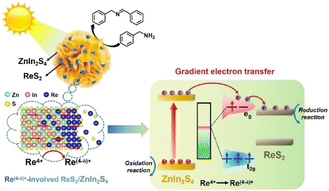
Directional and smooth charge transfer across the interface of heterojunction materials is pivotal in terms of photochemical activity. However, large lattice mismatch and disordered interfaces inevitably exist in actual-prepared heterojunctions, resulting in great uncertainty in interfacial charge migration. Herein, an ingenious strategy involving photoinduced metastable-charging of d-orbital electrons of the Re centers at the interface of ReS2/ZnIn2S4 (ReS2/ZIS) is clarified. This metastable interfacial electronic state is involved in the creation of gradient charge migration channels. The charging process increases the electron density occupancy, which provides a large electronic potential difference for the subsequent charge migration to ReS2. This gradient charge migration significantly accelerates the mobility and the electron injection rate at the interface, achieving a 6.2-fold and 7.7-fold improvement, respectively. Consequently, the optimized 10% ReS2/ZIS composite exhibits a conversion rate of 22.84 mmol gcat−1 h−1 for the photocatalytic oxidation amine, which is the highest efficiency achieved thus far for photocatalytic amine oxidation coupling on ReS2-based composites. This research furnishes original insights for charging orbital electrons to steer the kinetics of the charge transfer process and sheds light on the design of advanced heterojunction materials for efficient solar energy conversion.
 Please wait while we load your content...


