


 PLATFORM UPDATE:


Detonation nanodiamonds with ultrapure surfaces through a combined chlorine and fluorine gas treatment

Abstract
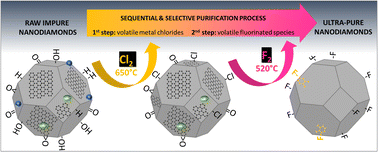
Achieving a highly purified surface of nanodiamonds of a calibrated size is of great interest considering the wide range of applications requiring perfect control for maximizing their properties and resulting performance. However, existing purification methods, involving strong acids and oxidants, suffer from a lack of selectivity because they can attack nanodiamonds and add new contaminants to the sample. In this work, a highly selective gas-phase approach that combines two halogen gases (chlorine and fluorine) is successfully developed. First, a treatment under elemental chlorine at 650 °C for 1 h is able to remove all inorganic impurities except silica. Second, a thermal treatment under elemental fluorine (at 520 °C for 12 h) is used to eliminate both silica and surface impurities (disorganized sp2 layers and oxygen- and hydrogen-containing functional groups) from size-calibrated detonation nanodiamonds. The resulting cleaned diamond surface is covered by carbon–fluorine bonds only. An in-depth investigation using several complementary techniques, including in situ characterizations, allows determination of the chemical reactions playing a major role in the manifested highly efficient impurity removal. The formation of fluorinated gases such as HF, CF4, and C2F6 is evidenced along with that of silicon fluorides such as SiF4. The role of fluorine as a stabilizing (“passivating”) agent for the surface is proposed by comparison with fluorinated diamane. These detonation nanodiamonds with an ultrapure surface show remarkable thermal stability, with a combustion temperature up to 225 °C higher than that of raw detonation nanodiamonds. These findings open the way to broadly extend the use of detonation nanodiamonds for applications requiring harsh reaction conditions, for which most nanomaterials are strongly limited.
 Please wait while we load your content...


