


 PLATFORM UPDATE:


Ca2+ substitution induced phase coexistence and synergistic regulation of Ti3+ defects to improve piezoelectric–photocatalytic water splitting performance of BaTiO3
 *ab
*ab
Abstract
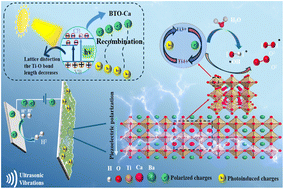
The synergistic effect between piezoelectricity and photocatalysis opens a new pathway for efficient water-splitting hydrogen production. However, limitations such as low mechanical energy conversion efficiency and poor directional charge transfer hinder its practical application. In this study, a BaTiO3-Ca0.2 photoanode with a coexisting tetragonal–orthorhombic phase involving Ti3+ defects and lattice distortion defects was synthesized by incorporating Ca2+ into BaTiO3. The results show that under ultrasonic treatment, the photocurrent density of BTO-Ca0.2 at 1.23 VRHE reaches 1.89 mA cm−2, which is 3.63 times that of pristine BaTiO3. DFT and experimental tests confirm that under ultrasonic treatment, the interface polarization gradient zone of the tetragonal–orthorhombic phase coexistence enhances the built-in piezoelectric field. Meanwhile, the modulation of the Ti3+ defect-induced orbital structure forms shallow energy levels, which improves charge separation and migration performance, accelerates the adsorption and dissociation of water molecules on the electrode surface, and leads to a comprehensive enhancement of piezoelectric–photocatalytic water splitting performance. These findings provide a feasible strategy for designing a high-performance piezo-photoelectric chemical (Piezo-PEC) efficient photoelectrode.
 Please wait while we load your content...


