


 PLATFORM UPDATE:


Nitrogen-doped WSe2 few-layer nanotubes for electrocatalytic nitrate reduction via Se vacancies

Abstract
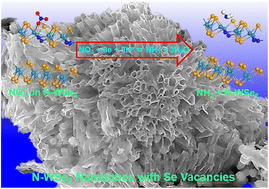
Unlike pure transition-metal dichalcogenides (TMDs) and chalcogen element-substituted TMDs, non-chalcogen element-doped TMDs could offer more extensive physicochemical properties. Moreover, closed few-layer TMD nanotubes (NTs) are unique considering the healing of the dangling bonds of the rim atoms of the layers invoked by the folding and seaming of layers. Electrochemical conversion of the nitrate group into ammonia represents a mild approach for the production of ammonia and economic utilization of NO3−-containing wastewater. Herein, nitrogen-doped tungsten diselenide (N-WSe2) few-layer NTs were prepared, physically characterized, and synchronously modulated by controlling the N content. Se vacancies (Sev) were introduced into N-WSe2 NTs, which resulted from the compensation of the charge imbalance when trivalent N3− were introduced in place of divalent Se2−. Accordingly, Sev served as the enhanced active sites for the electrocatalytic nitrate reduction reaction (NO3−RR), which is an effective avenue to nitrate depollution in water and catalytic ammonia synthesis. An ammonium yield rate of 35.6 mg cm−2 h−1 at −1.0 VRHE and faradaic efficiencies (FEs) of >93% were obtained, while the hydrogen evolution reaction (HER) was severely suppressed due to the elimination of the dangling bonds. A molecular orbital (MO) model in combination with density functional theory (DFT) theoretical computations revealed that Sev effectively enhanced the adsorption and activation of NO3−, reduced the energy barrier of the rate-determining step (RDS), and facilitated the formation of intermediates in the elementary steps. These theoretical models and analyses also interpret the high selectivity of the N-WSe2 NTs for the NO3−RR over the HER.
 Please wait while we load your content...


