


 PLATFORM UPDATE:


Carbon confinement engineering in high-density single-atom catalysts: boosting efficient electrochemical energy conversion

Abstract
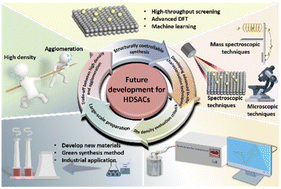
Single-atom catalysts (SACs) represent a breakthrough in maximizing atomic efficiency and reducing dependence on noble metals. However, their widespread application remains constrained by the challenges of achieving high metal loadings and maintaining stability under operational conditions. This review highlights the emerging paradigm of high-density single-atom catalysts (HDSACs) confined in carbon matrices as a transformative approach—an area largely overlooked in existing literature. By simultaneously enhancing active-site density and preserving atomic dispersion, carbon-confined HDSACs address the intrinsic limitations of conventional SACs, delivering unprecedented activity and durability in key electrochemical reactions, such as the ORR, OER, and NRR. This review provides a systematic analysis of carbon confinement engineering for HDSACs. First, it elucidates the dual-field (electric and magnetic) regulatory mechanisms governing catalytic enhancement, thereby establishing a conceptual framework for interpreting their catalytic behavior. Next, the work summarizes recent advances in synthetic strategies employing geometric spatial confinement and chemical coordination to stabilize high-density single atoms, offering versatile design principles tailored to diverse application scenarios. Furthermore, it explores the unique structure–activity relationships associated with dense atomic architectures. By integrating fundamental principles with practical applications, this review establishes a roadmap for next-generation electrocatalyst design, emphasizing the importance of interdisciplinary approaches to tackle global energy and environmental crises.
- This article is part of the themed collections: Journal of Materials Chemistry A Recent Review Articles and Journal of Materials Chemistry A HOT Papers
 Please wait while we load your content...


