



Efficient and stable perovskite solar cells processed with fluoroethylene carbonates
 *ab
*ab
Abstract
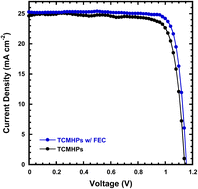
Studies demonstrated that metal halide perovskites (MHPs) are promising photovoltaic materials due to their excellent optoelectronic properties. However, the defects generated by uncoordinated counterions could induce the annihilation of charge transport, restricting device performance. In this study, we report the utilization of Lewis-based molecules, fluoroethylene carbonate (FEC) processing additives, to tune the physical properties of triple cation MHPs (termed TCMHPs). Systematic studies demonstrate that FEC processing additives interact with uncoordinated Pb2+, resulting in suppressed defects, enhanced and balanced charge transport, and suppressed nonradiative charge recombination. As a result, perovskite solar cells (PSCs) based on a TCMHP thin film processed with FEC additives exhibit over 24% power conversion efficiency (PCE) and suppressed photocurrent hysteresis compared to those based on the pristine TCMHP thin film. Moreover, the FEC processing additives modulate the hydrophobic properties of the TCMHP thin film, resulting in boosted stability for the PSCs based on the TCMHP thin film processed with the FEC additives compared to those based on the pristine TCMHP thin film. These results indicate that our studies of the utilization of processing additives to tune the physical properties of the TCMHP thin film are a simple way to boost the device performance of PSCs.
 Please wait while we load your content...


