


 PLATFORM UPDATE:


Role of Lewis base-type N sites of MOFs in achieving the preferential exposure of Zn(002) and HER-suppressed long-life zinc anodes
 *ad
and
*ad
and
Abstract
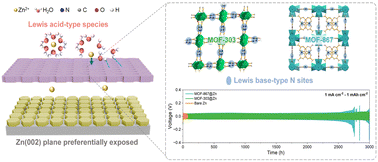
Developing efficient Zn anodes that can address side reactions and prevent Zn dendrite formation is highly demanded but remains a challenge for the development of stable zinc metal batteries. Herein, we fabricate a nitrogen-rich MOF layer on a Zn anode (MOF-303@Zn and MOF-867@Zn) to simultaneously regulate the preferred exposed Zn(002) plane and disrupt the intrinsic hydrogen-bond network. The Lewis base (LB)-type N sites of –N![[double bond, length as m-dash]](https://www.rsc.org/images/entities/char_e001.gif) NH moieties and bipyridine groups of MOF frameworks help to mediate interfacial H2O molecules via abundant H-bond acceptors/donors (i.e. Lewis acid sites/base sites), which not only reduces the amount of H-bonds at the electrolyte/electrode interface, but also de-solvates the [Zn(H2O)6]2+, inhibiting the H2O activity, thus mitigating the HER side reaction. In addition, the N sites along the channels facilitate Zn2+ conduction as hopping sites to achieve horizontally arranged (002) zinc platelet electrodeposition. The performance of MOF-303@Zn and bare Zn is systematically investigated to study the role of LB-type N sites of the MOF. Furthermore, MOF-867@Zn is introduced to evaluate the generality of the LB-type N-rich MOF protective layer. The cycling life of symmetric cells of MOF-303@Zn and MOF-867@Zn is over 3000 h, which is much longer than that of bare Zn. The MOF-303@Cu//Zn half-cell demonstrates a highly reversible Zn stripping/plating process over 1000 cycles, with an average CE of 99.31% at 1 mA cm−2. The MOF-303@Zn//NVO full cell at 5 A g−1 delivers a higher capacity retention rate of 90.4% after 1000 cycles. This work pioneers a molecular-level interfacial engineering strategy from the perspective of LB-type sites that synchronously addresses multiple fundamental challenges in zinc electrochemistry, establishing new paradigms for high-performance aqueous batteries.
NH moieties and bipyridine groups of MOF frameworks help to mediate interfacial H2O molecules via abundant H-bond acceptors/donors (i.e. Lewis acid sites/base sites), which not only reduces the amount of H-bonds at the electrolyte/electrode interface, but also de-solvates the [Zn(H2O)6]2+, inhibiting the H2O activity, thus mitigating the HER side reaction. In addition, the N sites along the channels facilitate Zn2+ conduction as hopping sites to achieve horizontally arranged (002) zinc platelet electrodeposition. The performance of MOF-303@Zn and bare Zn is systematically investigated to study the role of LB-type N sites of the MOF. Furthermore, MOF-867@Zn is introduced to evaluate the generality of the LB-type N-rich MOF protective layer. The cycling life of symmetric cells of MOF-303@Zn and MOF-867@Zn is over 3000 h, which is much longer than that of bare Zn. The MOF-303@Cu//Zn half-cell demonstrates a highly reversible Zn stripping/plating process over 1000 cycles, with an average CE of 99.31% at 1 mA cm−2. The MOF-303@Zn//NVO full cell at 5 A g−1 delivers a higher capacity retention rate of 90.4% after 1000 cycles. This work pioneers a molecular-level interfacial engineering strategy from the perspective of LB-type sites that synchronously addresses multiple fundamental challenges in zinc electrochemistry, establishing new paradigms for high-performance aqueous batteries.
- This article is part of the themed collection: Journal of Materials Chemistry A HOT Papers
 Please wait while we load your content...


