


 PLATFORM UPDATE:


Trans-interfacial distribution of Se vacancies in Bi2Se3 core and carbon nanofiber matrix enables long-lifespan and ultra-stable sodium storage
 *a
*a
Abstract
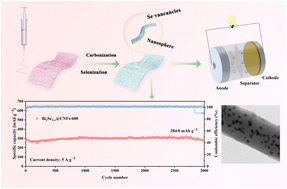
Despite the high capacity of metal selenides (MSes) anode materials for sodium-ion batteries (SIBs), they still face significant challenges, including rapid capacity degradation and slow reaction kinetics. Herein, a novel structure of Bi2Se3 nanospheres uniformly embedded in a nitrogen-doped carbon nanofiber matrix (denoted as Bi2Se3−x@CNFs) was constructed through a facile fabrication approach involving electrospinning, followed by one-step selenization, demonstrating exceptional performance as an SIB anode. The extremely high mechanical strength and consecutive fibrous structure of carbon fibers effectively alleviate the agglomeration and volume expansion of Bi2Se3 particles and ultimately improve stability and service life. Furthermore, the engineered selenium vacancy distribution in both Bi2Se3 nanospheres and carbon fiber substrates produces synergistic effects, significantly improves bulk electronic conductivity, and expedites redox reaction kinetics. As expected, the Bi2Se3−x@CNFs-600 electrode demonstrates high capacity and exceptional durability (327.8 mAh g−1 after 1000 cycles at 3.0 A g−1 and 284.0 mAh g−1 over 3000 cycles at 5.0 A g−1). It is noteworthy that the assembled Bi2Se3−x@CNFs//Na3V2(PO4)3 full cells demonstrate good rate capability and stability, rendering them a viable option for SIBs.
 Please wait while we load your content...


