


 PLATFORM UPDATE:


Enhanced green-light harvesting and PS II loading in CdTe QD-embedded IO-SnO2 bio-photoanodes for photocurrent generation

Abstract
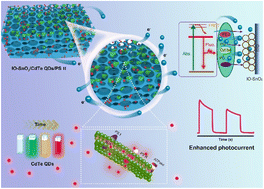
The biomimetic stacked thylakoid bioelectrode-like honeycomb structure presents potential as an electron collector, as well as an active substrate, in photoelectrochemical (PEC) systems. However, its interfacial electron transfer (IET) efficiency and lower green light utilization limit the overall performance. Herein, we developed a novel PEC system consisting of PS II, CdTe QDs and inverse opal SnO2 electrodes through self-assembly. We found that the macroporous structure mainly influences the PS II loading and IET and that the CdTe QDs could convert the green light into red light (678 nm) for the reabsorption by PS II. Therefore, the hybrid bioelectrode (IO-SnO2/CdTe QDs/PS II) exhibited an excellent photocurrent response of approximately 27 µA cm−2 (DET), which contributed to the conversion of green to red light, and the abundant conductive network of IO-SnO2 aided in the generation and transfer of electrons. Moreover, the mediator photocurrent response of the bioelectrode exhibited a substantial 300% increase (MET, approximately 72 µA cm−2) under solar light. This research offers promising approaches for designing photosynthetic protein-based nanohybrid systems and electric devices for solar energy conversion and storage.
 Please wait while we load your content...


