


 PLATFORM UPDATE:


Regulating Ni oxidation states through ruthenium incorporation in Ni based catalysts
 d
Serena
DeBeer,
d
Nuria
Romero,
b
Jordi
García-Antón,
a
Luis
Rodríguez-Santiago,
f
Xavier
Solans-Monfort,
f
Roger
Bofill,
a
Karine
Philippot,
*b
Laia
Francàs
*a
and
Xavier
Sala
*a
d
Serena
DeBeer,
d
Nuria
Romero,
b
Jordi
García-Antón,
a
Luis
Rodríguez-Santiago,
f
Xavier
Solans-Monfort,
f
Roger
Bofill,
a
Karine
Philippot,
*b
Laia
Francàs
*a
and
Xavier
Sala
*a
Abstract
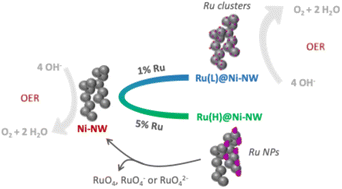
NiFe-based materials are state-of-the-art electrocatalysts for water oxidation at alkaline pH. Several strategies to improve their activity have been reported, amongst which Ru-incorporation has appeared as a suitable approach. In this work, three Ni based nanomaterials have been prepared through organometallic synthesis and surface-decorated with small (sub-nanometric) Ru clusters (Ru(L)@Ni-NW) or large (ca. 8 nm) Ru nanoparticles (Ru(H)@Ni-NW and Ru(HH)@Ni-NW). As model systems, Ru(L)@Ni-NW and Ru(H)@Ni-NW have been thoroughly characterized by a complementary set of advanced techniques, including atom probe tomography, X-ray absorption spectroscopy, X-ray photoelectron spectroscopy and high-angle annular dark-field scanning transmission electron microscopy. Our study reveals that Ru nanoparticles remain unstable under electrocatalytic oxygen evolution reaction (OER) conditions, leaching from the Ni based NW surface. In contrast, sub-nanometric Ru clusters remain stable on the Ni based NWs and modify the Ni oxidation states at the surface sites, outperforming the counterparts that contain no Ru or Ru nanoparticles. The spectroelectrochemical and DFT modelling results suggest the interaction between the Ru sub-nanometric clusters and the Ni sites as the origin of the stabilization of Ni at higher oxidation states, boosting the OER efficiency under both Fe-containing (unpurified electrolyte) and Fe-free (purified electrolyte) conditions.
 Please wait while we load your content...


