


 PLATFORM UPDATE:


Rational design of aqueous zinc-ion battery electrolytes based on intermolecular interactions between co-solvents and anions

Abstract
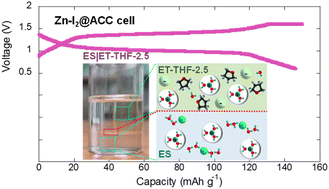
Despite their great promise as a sustainable alternative to lithium-ion batteries for stationary energy storage systems, aqueous zinc-ion batteries (AZIBs) continue to suffer from interfacial instability between metal anodes and electrolytes, stemming from the high activity of free water molecules in the electrolyte. Incorporating chaotropic co-solvents or additives with a strong affinity toward Zn has long been recognized as a viable and cost-effective approach to mitigate these issues, yet such strategies often face intrinsic miscibility limitations. To address this issue, we employed tetrahydrofuran (THF) to rationally design fully miscible electrolytes by balancing kosmotropic and chaotropic interactions between THF and anions in THF–H2O solutions. In these systems, THF not only disrupts the hydrogen-bonding network in water clusters, but also forms robust adsorbate layers on the zinc surface, suppressing Zn metal corrosion and promoting uniform and compact Zn deposition, thereby leading to excellent long-term electrochemical performance. Furthermore, the spontaneous phase separation into THF-rich and sulfate-rich phases, driven by the salting-out effect among THF, triflate and sulfate in aqueous solution, was exploited to prepare biphasic electrolytes capable of providing tailored electrolyte environments for the cathode and anode, respectively, in Zn–I2 batteries. This study offers new insights and opportunities to design advanced electrolytes to tackle longstanding challenges with various AZIBs.
- This article is part of the themed collections: Journal of Materials Chemistry A HOT Papers and Advanced aqueous batteries
 Please wait while we load your content...


