


 PLATFORM UPDATE:


Core-ligand modulation alters core–shell coordination to produce stable supercooled phase-change materials for long-term heat storage and release
 a
and
Zhubing
He
*a
a
and
Zhubing
He
*a
Abstract
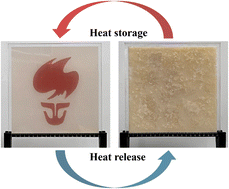
Hierarchical core–shell coordinated metal–organic networks came out recently as promising supercooled phase-change materials (SPCMs) that achieve both stable energy storage and controllable release for long-term energy storage and release. However, these new materials need further development, especially regarding the supercooling stability of the high-enthalpy composition. Here, we report a Mn-acetamidomethanol@erythritol (MA@Er) core–shell SPCM with high erythritol load achieved through core ligand modulation, simultaneously achieving both high supercooling stability and controllable crystallization. As revealed, the hydroxylic group of acetamidomethanol interacts with the erythritols in the core–shell, leading to a thermodynamic energy barrier over 5 times higher than the currently reported counterparts, resulting in only 7.8% loss of enthalpy after 1000 successive thermal charge–discharge cycles. MA@Er, with an enthalpy of 161 kJ kg−1, can release its latent heat to attain a temperature peak of 71.7 °C shortly after being triggered by a small shear stress of 8 Pa. Moreover, its thermal energy utilization efficiency reaches 86.3% when consuming low-grade waste heat. MA@Er core–shell SPCMs demonstrate great potential for practical utilization of low-grade thermal energy in the long-term mode.
 Please wait while we load your content...


