


 PLATFORM UPDATE:


Sulfide electrolyte additive enables multi-ionic transfer pathways in alkaline iron redox

Abstract
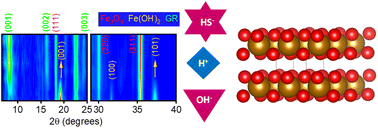
Traditional alkaline iron (Fe) batteries rely on the conversion reaction between Fe and Fe(OH)2 but suffer from hydrogen generation upon Fe formation on charging. Fe2+/Fe3+ redox is a promising anode reaction for alkaline Fe batteries, as it alleviates the formation of hydrogen gas during charging. However, achieving complete Fe2+/Fe3+ redox with a one-electron transfer reaction is challenging due to the formation of electrochemically inert Fe3O4 materials. Here, we demonstrate that an alkaline sulfide-containing electrolyte facilitates the reversible multi-ion transfer and transport pathways within (and beyond) the Fe2+/Fe3+ redox system, including Fe(OH)2/Fe3O4 conversion, intercalation of hydrosulfide into layered Fe(OH)2, and hydrogen deposition, mediated by hydroxyl ions, hydrosulfide anions, and protons, respectively. This multi-ionic charge storage mechanism delivers a compelling discharge capacity of up to 330 mA h g−1, as determined by chronopotentiometry measurements at a current density of 0.1 A g−1, exceeding the theoretical iron redox capacity solely relying on Fe2+/Fe3+ redox (∼299 mA h g−1). Our study will highlight the potential of alkaline iron redox as a green anode reaction for various aqueous energy storage systems by utilizing a scalable and low-concentration hydrosulfide electrolyte additive.
- This article is part of the themed collection: Advanced aqueous batteries
 Please wait while we load your content...


