


 PLATFORM UPDATE:

Selective nitrogen doping on porous hard carbons using polymer dopants for high-performance fuel cells

Abstract
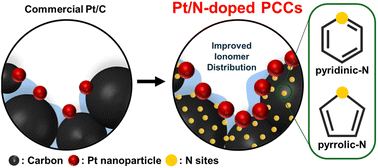
Nitrogen (N)-doped carbon materials have gained significant attention as promising electrocatalysts for the oxygen reduction reaction (ORR) in proton exchange membrane fuel cells (PEMFCs), yet their practical deployment is hindered by high synthesis cost and insufficient electrochemical stability. Herein, we introduce a polymer-assisted strategy leveraging poly(4-vinylpyridine) (P4VP) as both an N precursor and dispersing agent, enabling controlled N incorporation (1–2 at%) and homogeneous catalyst dispersion. The strong affinity of P4VP for graphitic surfaces mitigates aggregation, facilitating homogeneous doping and enhanced electrochemical durability. The catalyst demonstrates exceptional durability, exhibiting only a 4% voltage loss at 0.8 A cm−2 after 30 000 cycles while retaining over 50% of its initial electrochemically active surface area (ECSA), whereas the N-free counterpart suffers a severe 39% voltage loss, highlighting the crucial role of N doping introduced via P4VP in enhancing electrochemical stability. This work establishes polymer-assisted N doping as a cost-effective strategy for durable, high-performance PEMFC electrocatalysts.
 Please wait while we load your content...


