


 PLATFORM UPDATE:


Carbon nitride shielded Co–W–S interfaces for ultra-stable hydrogen evolution in harsh acidic media
 *a
Misook
Kang
*a
*a
Misook
Kang
*a
Abstract
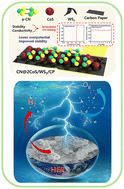
The hydrogen evolution reaction (HER) in strongly acidic media underpins proton-exchange-membrane (PEM) electrolysis, yet achieving precious-metal-free stability at industrial current densities remains a major challenge. Here, we report a carbon-nitride-armored Co–W–S heterostructure (CN@2CoS/WS2/CP) grown on carbon paper via hydrothermal deposition followed by melamine pyrolysis. WS2 nanosheets provide acid-resistant structural stability, CoS nanoparticles supply abundant redox-active sites, and a conformal amorphous CN overlayer enhances electronic conductivity, suppresses metal dissolution, and promotes defect formation. This integrated architecture delivers overpotentials of 154 and 176 mV at 10 and 100 mA cm−2 in 0.5 M H2SO4, along with a Tafel slope of 48.5 mV dec−1 and a turnover frequency of 0.168 s−1, outperforming all WS2- and CoS-based references. Electrochemical impedance and Cdl measurements (19.5 mF cm−2) confirm accelerated charge transfer and preserved electrochemically active surface area. Crucially, the electrode maintains continuous operation for 10 days at 500 mA cm−2 with undetectable Co/W leaching (0.00 ppm), retaining both morphology and chemical integrity. Density-functional-theory calculations reveal near-thermoneutral hydrogen adsorption (ΔGH ≈ −0.18 to −0.26 eV) at the Co–W–S interface and support a Volmer–Heyrovsky mechanism involving CN-stabilized H-spillover, consistent with H2-TPR and redox diagnostics. This study demonstrates that dynamic carbon-nitride shielding is an effective and scalable strategy for constructing acid-resilient HER electrodes capable of long-term high-current operation.
 Please wait while we load your content...


