


 PLATFORM UPDATE:


Electrochemical lithiation of the layered superionic conductors AgCrSe2 and CuCrSe2

Abstract
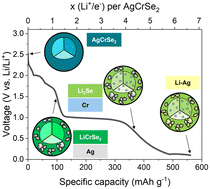
The layered transition metal chalcogenides MCrX2 (M = Ag, Cu; X = S, Se, Te) are of interest for energy storage because chemically Li-substituted analogs were reported as superionic Li+ conductors. The coexistence of fast ion transport and reducible transition metal and chalcogen elements suggests that this family may offer multifunctional capability for electrochemical storage. Here, we investigate the electrochemical reduction of AgCrSe2 and CuCrSe2 in non-aqueous Li- and Na-ion electrolytes using electrochemical measurements coupled with ex situ characterization (scanning electron microscopy, energy-dispersive X-ray spectroscopy, X-ray diffraction, and X-ray photoelectron spectroscopy). Both compounds delivered high initial specific capacities (∼560 mAh g−1), corresponding to 6.6 and 5.7 Li+/e− per formula unit for AgCrSe2 and CuCrSe2, respectively. We attribute this difference to distinct reduction pathways: (1) Li+ intercalation to form LiCrSe2 and extruded Ag or Cu, (2) conversion of LiCrSe2 to Li2Se, and (3) formation of an Ag–Li alloy at the lowest potential, operative only in AgCrSe2. Consistent with this proposed mechanism, step 3 was absent during reduction of AgCrSe2 in a Na-ion electrolyte since Ag does not alloy with Na. These results demonstrate the complex reduction chemistry of MCrX2 in the presence of alkali ions, providing insights into the use of MCrX2 materials as alkali ion superionic conductors or high capacity electrodes for lithium or sodium-ion type batteries.
 Please wait while we load your content...


