


 PLATFORM UPDATE:


Consecutive intra-particle phase transitions in the LiFePO4 battery electrode material

Abstract
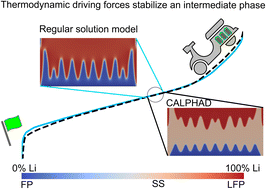
Mesoscale modeling of battery electrode materials requires accurate free energy data. Typical models employed assume the regular solution model, which accounts for ideal mixing entropy and weak interactions from the enthalpic contribution. However, this free energy description is insufficient when describing the LiFePO4 electrode due to the electrostatic interactions between its ionic species. This study addresses the asymmetry in the experimental phase diagram of LiFePO4, particularly the eutectoid point at 60% Li concentration, which the symmetric regular solution model fails to capture. We employ spline interpolations to capture this more complex free energy landscape within a phase-field model. Our findings reveal that when this asymmetry is accounted for, delithiation occurs through a solid solution pathway, driven by thermodynamic forces that induce an intermediate solid solution phase, thereby challenging the prevailing notion that this phase is only accessible at high charging rates at the nano-scale. The solid solution phase mitigates strain evolution and enhances delithiation rates compared to the conventional model, offering new insights into the phase transformation characteristics of LiFePO4 electrodes.
- This article is part of the themed collection: Celebrating International Women’s Day 2026: Women in Journal of Materials Chemistry A
 Please wait while we load your content...


