


 PLATFORM UPDATE:


Exploring the surface reconstruction of AgPdIr nanoalloys with a defined IrO2–AgPd heterostructure for exceptional formate oxidation
 *ab
*ab
Abstract
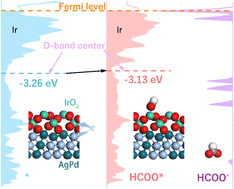
The reconstruction of oxide species on nanoalloy surfaces is ubiquitous and can profoundly influence the formate oxidation reaction (FOR) process, though the reconstruction often remains elusive yet critically important to unravel. We report the first successful growth of IrO2 on a AgPd nanoalloy to explore the reconstruction of O on the AgPdIr nanoalloy, and systematically investigate the influence of this inverse catalyst on FOR performance through integrated theoretical and experimental approaches. DFT calculations reveal that the Ir site on IrO2(200)-AgPd exhibits enhanced orbital overlap with HCOO*, facilitating electron transfer, while traditionally strong adsorption is counterbalanced by an up shifted d-band center of Ir induced by AgPd-to-IrO2 electron donation. Moreover, the adsorption energy of the key intermediate H* is reduced to −2.12 eV, significantly weaker than that on AgPd (−2.42 eV). The combined effects of rapid electron transfer and moderated adsorption energetics of HCOO* and H* yield exceptional formate oxidation reaction (FOR) performance. Experimentally, XPS confirms significant electron transfer from Ag to IrO2, and control experiments show that IrO2 growth is electron-donation-dependent. The catalyst also demonstrates a 3.8-fold current enhancement (5.21 vs. 1.36 A mgPd−1) and exceptional stability (65.6% activity retention after 600 cycles) relative to AgPd. This work establishes a blueprint for designing advanced inverse catalysts through interfacial electronic-structure control.
- This article is part of the themed collection: Journal of Materials Chemistry A HOT Papers
 Please wait while we load your content...


