


 PLATFORM UPDATE:


Unraveling the sodium storage mechanism in a redox-active covalent organic framework cathode for Na-metal batteries
 †a
Asia
Patriarchi,
†b
Leonardo
Sbrascini,
d
Hegoi
Manzano,
c
Javier
Carrasco,
ef
Manuel
Souto
*ag
and
Miguel Ángel
Muñoz-Márquez
*bdh
†a
Asia
Patriarchi,
†b
Leonardo
Sbrascini,
d
Hegoi
Manzano,
c
Javier
Carrasco,
ef
Manuel
Souto
*ag
and
Miguel Ángel
Muñoz-Márquez
*bdh
Abstract
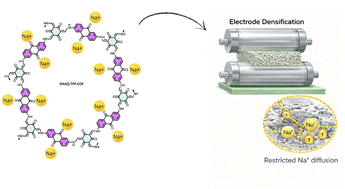
Sodium-based batteries are gaining increasing attention due to the abundant availability of sodium, among these, sodium-metal batteries (SMBs) are a promising solution. However, the development of suitable electrode materials for SMBs remains a significant challenge. Organic materials such as two-dimensional covalent organic frameworks (2D COFs) have emerged as promising electrodes due to their vast versatility, although their sodium storage mechanism remains poorly understood. In this work, the sodium storage mechanism of a β-ketoenamine anthraquinone-based COF (DAAQ-TFP), employed as a cathode for SMBs, is unveiled through a combination of electrochemical, physicochemical, and computational studies. In contrast with previous studies suggesting a capacitive storage mechanism, our results reveal a combination of pseudocapacitive and faradaic processes. Molecular dynamic simulations combined with ex situ X-ray diffraction studies confirmed that sodium storage occurs via interaction with carbonyl groups located within the COF channels rather than through intercalation between the COF layers. Moreover, electrode calendering experiments demonstrate that the faradaic contribution is governed by the porous COF structure. Finally, the redox inactivity of the carbonyl groups of the β-keto units is demonstrated through both computational and electrochemical measurements. These results further reinforce the role of anthraquinone units as the sole active sites responsible for sodium storage in this type of organic electrode materials.
- This article is part of the themed collection: Celebrating International Women’s Day 2026: Women in Journal of Materials Chemistry A
 Please wait while we load your content...


