


 PLATFORM UPDATE:


The role of AI in the advancement of 2D materials for biosensing and nanoelectronics
 *a
Matin
Ashurov,
c
*a
Matin
Ashurov,
c
Abstract
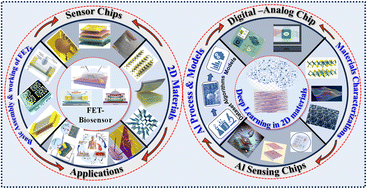
Significant progress in biosensing and nanoelectronics has emerged from the amalgamation of two-dimensional (2D) materials, including graphene, molybdenum disulfide (MoS2), and hexagonal boron nitride (hBN), with artificial intelligence (AI) and machine learning (ML). The enhanced electrical, mechanical, and chemical capabilities of these materials account for this phenomenon. This work examines the convergence of artificial intelligence and two-dimensional materials, emphasizing the capacity of AI-driven algorithms and machine learning models, such as Mask R-CNN, to efficiently and precisely characterize 2D materials, thereby enhancing significantly sensor performance. AI transcends the constraints of traditional human methods by automating the identification and examination of nanoscale materials. This enhances the process's speed and precision to unprecedented levels. Machine learning techniques are highly effective at forecasting significant electrical, mechanical, and thermodynamic material properties. This accelerates the design process of functional 2D materials for targeted applications. The integration of AI with 2D material-based biosensors enhances their sensitivity, selectivity, and stability, thereby addressing critical issues such as sensor drift, cross-sensitivity, and long-term reliability. Nevertheless, despite these advancements, considerable problems remain in the scalable synthesis of high-quality 2D materials, their integration with conventional semiconductor technologies, and their cost-effective production. AI-driven optimization and hybrid integration techniques are effective approaches to address these challenges and facilitate the commercialization of next-generation biosensing technologies. The integration of AI with 2D materials will transform various industries, including personalized medicine, environmental monitoring, and intelligent electronics. This will enable the development of adaptive, real-time biosensing platforms and enhanced wearable health sensors. This paper demonstrates the potential of AI-enhanced 2D materials to transform the future of biosensing and nanoelectronics. It also provides a comprehensive strategy for future transdisciplinary research and scalable technology implementations.
- This article is part of the themed collection: Journal of Materials Chemistry A Recent Review Articles
 Please wait while we load your content...


