


 PLATFORM UPDATE:


Highly efficient and free-standing WS2/C electrocatalyst for solar-cell-driven hydrogen evolution reaction
 *b
and
*b
and
Abstract
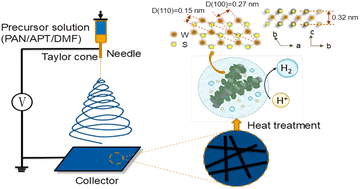
Developing non-precious metal electrocatalysts is an important strategy for achieving sustainable hydrogen production from water electrolysis. Carbon-based transition metal dichalcogenides (TMDs) demonstrate a synergistic effect in hydrogen evolution reaction (HER) catalytic performance, thereby exhibiting potential as cost-effective alternatives to platinum-group metals. However, they still suffer from many challenges that hinder their practical applications, primarily including insufficient exposure of active edge sites and substantial resistance to electron transport. Addressing these limitations requires the development of effective strategies to enhance active site density through controlled structural modulation. Herein, we demonstrate a two-step approach involving electrospinning followed by sulfurization heat treatment to fabricate a tungsten disulfide/carbon (WS2/C) composite HER catalytic electrode. Plasma treatment is utilized to effectively control the morphology of the composite structures. Characterization results reveal that WS2 nanosheets are vertically embedded on the surface of carbon fibers and are highly dispersed on the carbon fiber skeleton. The hybrid structure significantly increases the density of exposed edge active sites while providing fast electron transport pathways through the highly conductive basal planes of the nanosheets. Furthermore, the high specific surface area of the carbon fiber skeleton enhances porosity, facilitating mass transfer and diffusion during the catalytic process. Electrochemical results demonstrate that in acidic electrolyte, the WS2/C electrode exhibits an onset potential of −60 mV and a Tafel slope of 95 mV dec−1. A carbon-based non-precious metal photovoltaic-driven hydrogen evolution system is formed by connecting a carbon-based solar cell module in series with the water electrolysis cell. The corresponding solar-to-hydrogen conversion efficiency reaches 4.4%. These findings indicate that the carbon fiber skeleton and catalyst nanosheets can synergistically improve the catalytic activity of the WS2/C composite electrode, and provide references for developing efficient, free-standing, non-precious metal HER catalytic materials.
 Please wait while we load your content...


