


 PLATFORM UPDATE:


Decoupling the capacity fade contributions in polymer electrolyte-based high-voltage solid-state batteries

Abstract
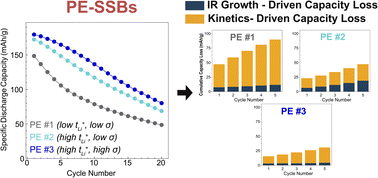
Polymer electrolyte (PE)-based solid-state batteries (PE-SSBs) made with high-voltage cathodes are known to suffer from severe capacity fade, stemming primarily from the poor oxidative stability of most PEs under high-voltage cycling conditions. PEs also suffer from greater ion-transport limitations compared to liquid or solid electrolytes. However, often, these limitations are collectively stated to be responsible for the observed capacity fade, and it is challenging to decouple the contributions of different factors. Herein, a tunable cell fabrication platform was developed to systematically investigate and decouple the two primary capacity fade drivers (cell impedance growth and kinetic limitations), while keeping the other cell parameters constant. Three PE types with distinct transport characteristics were compared. By utilizing a voltage profile analysis method, the contribution of the cell's internal impedance growth was quantitatively decoupled from the kinetic limitations stemming from the high concentration gradient in the polymer catholyte and slow charge transfer reactions. We demonstrate that the high interfacial impedance did not necessarily correlate with the high capacity fade rate. Kinetic limitations that are not reflected by impedance measurements can play a dominant role in causing cumulative capacity decay.
 Please wait while we load your content...


