


 PLATFORM UPDATE:


Unveiling the kinetic mechanism of oxygen vacancy and N-doping co-modified SrTiO3(100) for photocatalytic conversion of CO2 and H2O into CH4via associative proton transfer: insights from ab initio molecular dynamics
 *a
Yanwei
Zhang
*a
*a
Yanwei
Zhang
*a
Abstract
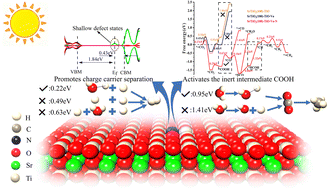
Photocatalytic conversion of CO2 and H2O into valuable CH4 has emerged as an appealing strategy for environmental remediation and sustainable energy production. However, a fundamental understanding of the kinetic mechanisms governing the full elementary reaction chain at the atomic scale in H2O-mediated CO2 reduction has remained elusive. Therefore, this study combines density functional theory (DFT) and ab initio molecular dynamics simulations with the slow-growth sampling (SG-AIMD) method to explore the kinetic characteristics of the full elementary reaction chains in the photocatalytic conversion of CO2/H2O to CH4. The calculation results reveal the kinetic preference for CO2 adsorption at the TiO-terminated SrTiO3(100) gas–solid interface and further elucidate the dominant role of the associative proton transfer mechanism in both CO2 protonation and the hydrogen evolution reaction (HER). More importantly, the nitrogen (N)-doped surface with oxygen vacancies (Vo) introduces shallow defect states below the conduction band minimum (CBM), enhancing electron injection upon photoexcitation. Furthermore, it promotes the activation of the *COOH intermediate, which significantly lowers the reaction kinetic barrier. This dual functionality collectively accelerates the H2O-mediated proton transfer kinetics in the photocatalytic conversion from CO2/H2O to CH4. This work unveils the dynamic evolution mechanism of photocatalytic CO2/H2O → CH4 at the atomic scale, offering theoretical guidance for the design of efficient solar fuel catalysts.
 Please wait while we load your content...


