


 PLATFORM UPDATE:

Performance and diffusion optimization mechanism in Al-assisted grain boundary diffused Nd–Fe–B magnets

Abstract
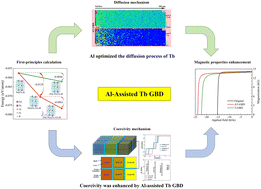
The grain boundary diffusion (GBD) method employing heavy rare-earth (HRE) elements effectively enhances the coercivity of sintered Nd–Fe–B magnets, yet often at the expense of the squareness factor. This trade-off remains a fundamental limitation in the pursuit of high-performance permanent magnets. Here, Al micropowder mixed with TbH3 nanopowder was used as a diffusion source to fabricate GBD Nd–Fe–B magnets. The optimized magnets exhibit superior overall performance compared with conventional Al-free counterparts: an 8.7 kOe increase in coercivity with only 0.5 wt% Tb, a squareness factor of 0.94, a coercivity temperature coefficient of −0.495%/°C, and significantly reduced irreversible flux loss at elevated temperatures. Combined first-principles calculations, micromagnetic simulations, and experimental analyses reveal that Al promotes liquid-phase diffusion by opening HRE GBD channels, deepening Tb penetration, and mitigating concentration gradients. Moreover, Al diffuses into the main phase ahead of Tb, lowering the energy barrier for Tb incorporation and facilitating the formation of core–shell structured grains. Fine control of Al content enables the simultaneous optimization of both liquid- and solid-phase diffusion, resulting in a comprehensive improvement of magnetic performance. These findings provide valuable guidance for the development of high-performance permanent magnet materials.
 Please wait while we load your content...


