


 PLATFORM UPDATE:


An electronic transmission bridge via 3D N-doping for steering urea electrosynthesis

Abstract
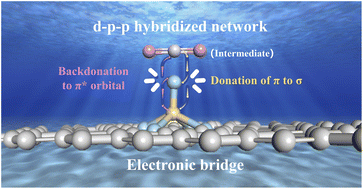
Electrochemical urea synthesis from CO2 and NO emerges as a promising alternative to the energy-intensive Haber-Bosch process, yet efficient C–N coupling is limited by suboptimal electronic structures and reaction kinetics, even for high-atomic utilization single-atom catalysts (SACs). Here, a 3D nitrogen (3D N)-doped SAC design is reported, where the conventional Cu-N-C framework is reorganized into a quasi-octahedral Cu-N5-C structure and serves as an “electronic bridge” to enable d–p–p hybridization and promote electron-mediated C–N bond formation. DFT calculations show that the 3D N bridge enhances π-electron acceptance from CO2 into N p-orbitals and d-orbital electron backdonation from Cu to CO2 π*-orbitals, strengthening C–N covalency and enabling ultrafast charge transfer. The 3D N doping shifts the Cu d-band center from −2.73 to −2.31 eV, improving intermediate adsorption and enabling a reaction pathway where proton-coupled electron transfer alternates with C–N coupling while reducing competing reactions. Ab initio molecular dynamics (AIMD) simulations further confirm the structural stability of the catalyst at 298 K, demonstrating no atomic agglomeration over a 10 ps period and underscoring the design of promising approaches for efficient electrochemical urea synthesis. This study provides critical insights into electron-driven electrocatalysis mechanisms, offering a rational framework for designing high-performance catalysts for urea production.
 Please wait while we load your content...


