


 PLATFORM UPDATE:


Tungsten oxide electron transport layer enables unprecedented operational stability in MAPbI3 p–i–n perovskite solar cells
 *ab
Lyubov A.
Frolova,
c
Ivan S.
Zhidkov,
de
Xueqing
Xu,
f
Sergey M.
Aldoshin
c
and
Pavel A.
Troshin
*ac
*ab
Lyubov A.
Frolova,
c
Ivan S.
Zhidkov,
de
Xueqing
Xu,
f
Sergey M.
Aldoshin
c
and
Pavel A.
Troshin
*ac
Abstract
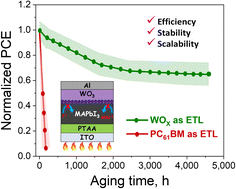
The operational instability of perovskite solar cells (PSCs), particularly at realistically high temperatures of >50 °C, remains a primary barrier to their commercialization. Methylammonium lead iodide (MAPbI3) is a prototypic perovskite absorber material notoriously susceptible to degradation under moisture, light, and heat, thus representing an ideal model system for designing new materials and device configurations for operational stability improvement. In this work, we address this critical issue by engineering a stable MAPbI3/tungsten(VI) oxide (WOx) interface within a p–i–n device architecture. Depositing the WOx electron transport layer (ETL) directly atop the perovskite absorber or using C60 as an interlayer provides decent power conversion efficiencies (PCEs) of 19.2%. Infrared scattering-type scanning near-field optical microscopy (IR s-SNOM) reveals that the thermally evaporated WOx forms a highly uniform and compact layer, providing complete coverage of the underlying perovskite. The devices with a simple structure (ITO/PTAA/MAPbI3/WOx/Al) demonstrate exceptional operational stability, retaining >70% of the initial performance after 4600 hours of continuous light soaking (100 mW cm−2) at 60 °C under open circuit conditions and without encapsulation. We attribute this stability to the formation of a robust interface between PbI2 and WOx, which remains intact under illumination. Crucially, the WOx layer acts as a protective barrier, effectively suppressing the evaporation of volatile decomposition products and preventing electrode corrosion. This work establishes the application of the tungsten oxide ETL as a highly promising strategy for achieving long-term operational stability in p–i–n PSCs, which is strongly demanded for commercial applications of perovskite photovoltaics.
 Please wait while we load your content...


