


 PLATFORM UPDATE:


Phonon RIXS signatures reveal polaron formation in oxygen redox Li- and Na-ion battery cathodes

Abstract
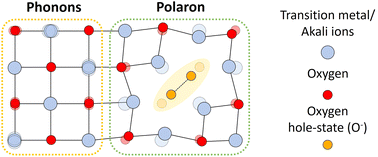
Oxygen redox (OR) in Li1.2Ni0.13Co0.13Mn0.54O2 and Na0.67Mg0.28Mn0.72O2 has been associated with the formation of embedded molecular O2 due to the appearance of their distinctive features in RIXS, while it is unclear whether OR also affects the oxygen left in the lattice. Here we use high-resolution oxygen K-edge resonant inelastic X-ray scattering (RIXS) at threshold excitation (527.5–529.5 eV) revealing lattice responses due to OR. We find that both cathodes show pronounced multiphonon progressions, which are either altered or activated upon charging. The first progression, with a fundamental energy loss ∼67–74 meV, matches the A1g lattice-oxygen mode observed by Raman spectroscopy, confirming its bulk origin. The second progression that exhibits a fundamental loss of ∼98 meV appears only at the highest state of charge and is resonant with the new pre-edge states at 527.5 eV. The latter mode emerges concurrently with the characteristic trapped-O2 RIXS signal and is strongly coupled to an occupied electronic band near the Fermi level, indicating that OR may not only contribute to the formation of molecular O2, but also perturbs lattice oxygen states, likely via polaron-forming oxidized lattice oxygen.
 Please wait while we load your content...


