


 PLATFORM UPDATE:


Surface engineered sulvanite integrated with layered double hydroxide for asymmetric hybrid supercapacitor

Abstract
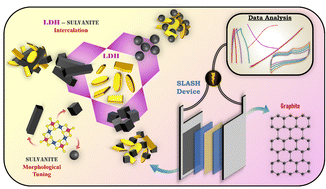
Layered double hydroxides (LDHs) are an emerging material, owing to their unique 2-D flake like morphology giving them a rapid diffusion characteristic. Surface tuning of Cu3VS4 sulvanite was performed to obtain various novel 3-D morphologies, to be integrated with 2-D mesoporous Ce(III)–Mg(II)–Y(III) LDH by a facile cost-effective approach. The 3-D structure of sulvanite enhances the surface area and number of active sites around the surface, allowing excellent redox behaviour. The integration of 3-D sulvanite with the 2-D LDH gave rise to a unique synergistic effect, resulting in an outstanding specific capacitance of 1456.6 F g−1 with 98.8% retention of its initial capacitance after 10 000 charge–discharge cycles, for cubic sulvanite integrated LDH (LD-C). A sulvanite LDH asymmetric supercapacitor hybrid (SLASH) device was fabricated using LD-C, showing the specific capacitance of 52.5 F g−1 at 1 A g−1, exhibiting an exceptional power density of 756.8 W Kg−1 at an energy density of 67.2 Wh Kg−1. The device exhibited an outstanding durability of 98.9% after 12 000 charge discharge cycles, displaying capable endurance when applied in real world energy storage applications.
- This article is part of the themed collection: Supercapacitors for a sustainable energy future
 Please wait while we load your content...


