


 PLATFORM UPDATE:


Designing type-II p-SiCC4/XO (X = Sn, Pb) van der Waals heterojunctions with a built-in electric field as promising photocatalysts for highly efficient overall water splitting
 *cd
and
Yuanfeng
Xu
*a
*cd
and
Yuanfeng
Xu
*a
Abstract
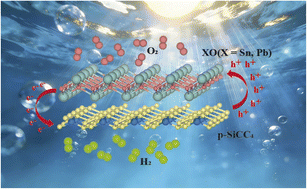
To overcome the intrinsic exciton utilization bottlenecks in two-dimensional photocatalysis, we designed novel p-SiCC4/XO (X = Sn, Pb) van der Waals heterojunctions and systematically investigated the exciton-related properties and photocatalytic performance using first-principles calculations. The results demonstrate that the p-SiCC4/XO (X = Sn, Pb) heterojunctions possess 2.00 and 2.18 eV indirect band gaps and type-II band alignment, and the band edge alignments fully span the redox potentials of water splitting. These heterostructures also exhibit distinctive auxetic characteristics with the maximum values of −0.05 and −0.025, respectively. The interfacial built-in electric field drives spatial charge separation and sustains long radiation lifetime interlayer excitons (1.1–2.6 ns), enabling efficient exciton dissociation with suppressed recombination. More importantly, the p-SiCC4/XO (X = Sn, Pb) heterojunctions can spontaneously drive the oxygen evolution half-reaction at pH = 7; however, the overall water splitting redox reaction on the p-SiCC4/PbO heterojunction can be nearly spontaneously driven under light illumination at pH = 0. In addition, the p-SiCC4/XO (X = Sn, Pb) heterojunctions yield exceptional solar-to-hydrogen efficiencies of 16.87% (p-SiCC4/SnO) and 12.67% (p-SiCC4/PbO). These findings indicate that these heterojunctions show great application prospects as water splitting photocatalysts.
 Please wait while we load your content...


