


 PLATFORM UPDATE:


Defect-engineered silica with temperature-responsive conversion of yellow and blue afterglow
 *a
*a
Abstract
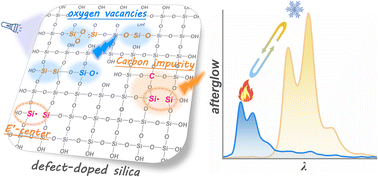
The afterglow properties of a single system are unable to achieve wide-range temperature-response conversion, constraining the development of tunable multi-emission afterglow. Here, we report a defect engineering strategy to achieve temperature-responsive conversion between blue and yellow afterglow properties in metal-free doped silica over a wide temperature range. Defects including intrinsic oxygen vacancies and extrinsic carbon impurities were co-introduced and stabilized within densified silica matrices. The carbon impurities activated partial oxygen defects and converted them from non-radiative centers into emissive centers, thus enhancing the yellow afterglow of oxygen vacancies that was typically suppressed. Dexter electron transfer for capturing released electrons plays a pivotal role in yellow afterglow. The doped silica exhibited a long afterglow duration exceeding 19 s at r.t., with a maximum lifetime of 3.54 s and a quantum yield of 16.68%. The broad-band afterglow spectra feature multi-emission profiles and distinct temperature-dependent afterglow dynamics. Silica densification provided rigid structural confinement, establishing physical barriers that shielded the defects from common passivation factors, thus ensuring robust photoluminescence properties. By leveraging the unique and robust temperature-responsive photoluminescence characteristics, we successfully demonstrated the doped silica for spatiotemporal-temperature anti-counterfeiting applications. Our findings offer valuable insights and a universal strategy for the rational design of defect-related afterglow materials and their tunable afterglow emission.
 Please wait while we load your content...


