


 PLATFORM UPDATE:


Engineered cellulose-supported photocatalysts for clean energy and environmental remediation: progress and prospects

Abstract
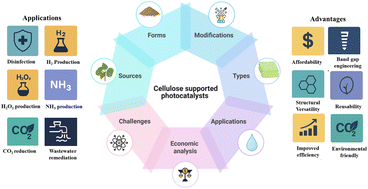
The growing global demand for sustainable energy and environmental remediation has accelerated interest in efficient, metal-free photocatalysts. Cellulose, known for its abundance, biodegradability, tunable chemistry, high surface area, and mechanical robustness, has emerged as an ideal support material for photocatalytic systems. This review presents a comprehensive evaluation of cellulose-supported photocatalysts, detailing their structural forms, physicochemical properties, preparation strategies, and design principles. The classification of cellulose-based composites and structured architectures into hydrogels, aerogels, membranes, and sponges highlights the versatility of cellulose in enhancing catalyst dispersion, charge separation, visible-light activity, and reusability. Their applications include hydrogen and hydrogen peroxide generation, nitrogen fixation, CO2 reduction and wastewater treatment and disinfection. Strengths, weaknesses, opportunities, and threats (SWOT) analysis provides insights into their strengths, limitations, and research gaps, emphasizing challenges in large-scale fabrication, stability, and commercial viability. Furthermore, this review highlights the significance of environmental and economic analyses to guide their sustainable scale-up and market adoption. Future directions should focus on heterostructure engineering, defect modulation, green synthesis, AI-guided optimization, and integration into real-world systems. By bridging materials science, catalysis, and environmental engineering, cellulose-supported photocatalysts hold significant potential for scalable, eco-friendly, and multifunctional solutions aligned with the fundamentals of circular economy, green chemistry, and the United Nations Sustainable Development Goals.
- This article is part of the themed collections: Journal of Materials Chemistry A Recent Review Articles, Editor Spotlight on photocatalysis: Welcoming Scientific Editor Yongfa Zhu and Advances in Sustainable Catalysis: from Materials to Energy and Environmental Applications
 Please wait while we load your content...


