


 PLATFORM UPDATE:


Concentration-tailored interphase engineering in solid-state polymer electrolytes for high-voltage lithium metal batteries

Abstract
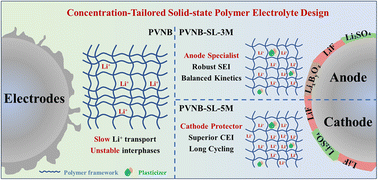
Achieving long-term cycling stability remains a tremendous challenge for solid-state lithium metal batteries, primarily due to low ionic conductivity, narrow electrochemical stability windows and poor interfacial contact inherent in many solid polymeric electrolyte systems. Herein, a solid-state electrolyte is developed by immobilizing a sulfone-based plasticizer within a polymer framework, while systematically optimizing lithium salt composition and concentration to address interfacial instability (PVNB-SL-XM, where X = 1, 3 and 5 denotes the concentration of the lithium salt in mol L−1). This tailored electrolyte stabilizes the Li anode through the balancing of fast kinetics, mechanical performance and good compatibility in PVNB-SL-3M, while constructing an optimal CEI in PVNB-SL-5M owing to the best Li+ solvation structure. Consequently, a LiNi0.8Co0.1Mn0.1O2‖ PVNB-SL-5M‖Li cell delivers a high capacity retention of 73.0% after 250 cycles with an ultrathin and uniform cathode–electrolyte interphase (∼7 nm). These findings provide a tailored electrolyte strategy based on the most performance-limiting electrodes, enabling durable high-voltage solid-state lithium metal batteries.
 Please wait while we load your content...


