Simple additive strategy to boost initial coulombic efficiency by mitigating PTFE decomposition in dry battery electrodes

Abstract

Dry-processed electrodes eliminate energy/capital-intensive solvent drying processes, but indispensable polytetrafluoroethylene (PTFE) binders suffer from electrochemical reduction by lithium due to the inherently low energy level of their lowest unoccupied molecular orbital (LUMO). We present a strategy to overcome this problem by elevating the LUMO with amine-containing additives, which remove the reduction signature – shoulder in voltage profiles – observed during anode lithiation. The modification, achieved via interaction between PTFE's fluorine atoms and the additive's amine group, has been validated by multiple experimental techniques and density functional theory calculations. The additive boosted both initial coulombic efficiency and mechanical durability. Our readily implementable approach involving simple mixing of PTFE with additives opens the door for broader adoption of dry-processed electrodes, addressing one of the most significant impediments in industrialization.
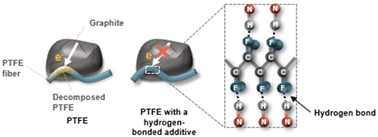
Graphical abstract: Simple additive strategy to boost initial coulombic efficiency by mitigating PTFE decomposition in dry battery electrodes

Supplementary files

Transparent peer review

To support increased transparency, we offer authors the option to publish the peer review history alongside their article.

View this article’s peer review history

Article information

Article type
Paper
Submitted
13 Sep 2025
Accepted
15 Nov 2025
First published
18 Nov 2025
This article is Open Access
Creative Commons BY-NC license

J. Mater. Chem. A, 2026, Advance Article

Simple additive strategy to boost initial coulombic efficiency by mitigating PTFE decomposition in dry battery electrodes

H. Park and C. Yu, J. Mater. Chem. A, 2026, Advance Article , DOI: 10.1039/D5TA07497E

This article is licensed under a Creative Commons Attribution-NonCommercial 3.0 Unported Licence. You can use material from this article in other publications, without requesting further permission from the RSC, provided that the correct acknowledgement is given and it is not used for commercial purposes.

To request permission to reproduce material from this article in a commercial publication, please go to the Copyright Clearance Center request page.

If you are an author contributing to an RSC publication, you do not need to request permission provided correct acknowledgement is given.

If you are the author of this article, you do not need to request permission to reproduce figures and diagrams provided correct acknowledgement is given. If you want to reproduce the whole article in a third-party commercial publication (excluding your thesis/dissertation for which permission is not required) please go to the Copyright Clearance Center request page.

Read more about how to correctly acknowledge RSC content.

Social activity

Spotlight

Advertisements