


 PLATFORM UPDATE:


Amplified emission from halide perovskite quantum dots by exciton–plasmon-coupled energy transfer in the neutral and trion states on gold nanoparticles
 *ac
Syoji
Ito,
d
Naoto
Tamai,
e
Hiroshi
Miyasaka,
d
Hiroaki
Misawa
cf
and
Vasudevanpillai
Biju
*ac
*ac
Syoji
Ito,
d
Naoto
Tamai,
e
Hiroshi
Miyasaka,
d
Hiroaki
Misawa
cf
and
Vasudevanpillai
Biju
*ac
Abstract
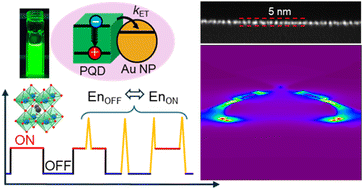
Exciton–plasmon coupling enhances the absorption and emission rates, photoluminescence intensity, and device performance of quantum dots in solar cells, light-emitting diodes, lasers, and photocatalysis. While localized surface plasmon resonance coupling has been extensively studied in metal nanoparticle–quantum dot systems, the precise mechanism of plasmon-coupled exciton generation and recombination in halide perovskite quantum dots and nanocrystals remains subtle. We report chemically induced exciton–plasmon coupling between Au nanoparticles and methylammonium lead bromide (MAPbBr3) perovskite single quantum dots, leading to efficient energy transfer from the plasmon to the neutral and charged (trion) exciton states of quantum dots, significantly enhancing the absorption and radiative relaxation rates. Time-resolved single-particle photoluminescence and transient absorption measurements reveal that Pb–Br⋯Au interactions and chemical interface damping accelerate radiative relaxation and bleach recovery rates. Additionally, focused ion beam-assisted scanning transmission electron microscopy imaging and finite-difference time-domain simulations highlight the roles of Au nanoparticles in exciton–plasmon coupled enhanced light absorption and amplified emission offering insights for high-performance plasmonic–perovskite hybrid devices.
- This article is part of the themed collection: Celebrating International Women’s Day 2026: Women in Journal of Materials Chemistry A
 Please wait while we load your content...


