


 PLATFORM UPDATE:


Engineering pore-confined ultrafine Pt nanoparticles in hollow mesoporous carbon spheres for synergistically enhanced bifunctional electrocatalysis in sustainable hydrogen evolution and ethylene glycol oxidation

Abstract
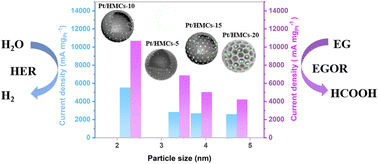
Rational design of Pt-based electrocatalysts necessitates precise control over nanoparticle size and electronic structure to optimize activity and durability. Based on the established mesopore-confinement concept, we synthesized size-controllable ultrafine Pt nanoparticles confined in hollow mesoporous carbon spheres (HMCs) with adjustable pore diameters (5–20 nm). The pore size controls Pt NP size, which modulates its work function, d band center and intermediate adsorption energy, thereby steering the reaction pathway. For the hydrogen evolution reaction (HER), Pt/HMCs-10 delivers a mass activity of 5534 mA mgPt−1 at −40 mV (vs. RHE), 15.7 times higher than that of Pt/C, owing to optimized work function modulation and accelerated charge transfer. In the ethylene glycol oxidation reaction (EGOR), it achieves a mass activity of 10 696 mA mgPt−1, 3.8 times higher than that of Pt/C, which is attributed to stabilized *OC–CH2OH intermediates (ΔG = 7.54 kJ mol−1) and efficient C–C cleavage. The mesoporous architecture ensures exceptional Pt nanoparticle dispersion and long-term stability. This work not only validates the power of mesopore confinement, but also advances it by establishing how pore size simultaneously tunes electronic properties and reaction pathways for multifunctional catalysis.
 Please wait while we load your content...


