


Precisely controlled low-valent nickel sites in planar polyphthalocyanine for enhanced urea oxidation

Abstract
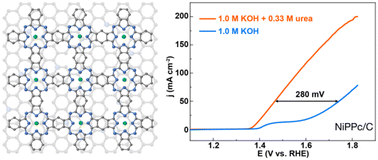
The electrocatalytic urea oxidation reaction (UOR) offers a sustainable method for hydrogen production. Spatially confining metal active sites is key to efficient UOR electrocatalysts, maximizing atom utilization and defining coordination. However, these metal atoms, which have high surface energy, tend to aggregate, and the synthesis of a controllable and uniformly coordinated structure is difficult. Here, we develop two-dimensional (2D) nickel-polyphthalocyanine-based covalent organic polymers, combined with hollow carbon nanospheres (NiPPc/C). The ordered atomic Ni–N sites in large-scale horizontal NiPPc crystals increase the number of exposed sites. Additionally, the Ni metal valence state is below 2 due to the strong π–π interaction between the NiPPc active layers and the carbon substrate, providing more effective electrons. NiPPc/C exhibits a lower potential of 1.46 V for the UOR than the 1.74 V required for the OER to achieve 50 mA cm−2. Theoretical studies further demonstrate that the delocalization of electrons within the Ni–N bond and the upward shift in the d-band center of the Ni sites enhance the adsorption binding of urea on these sites. Additionally, the free energy barrier for deprotonation decreases, thereby leading to improved catalytic activity for the UOR. This work outlines precise Ni-site design for small-molecule-assisted water splitting.
 Please wait while we load your content...


