


 PLATFORM UPDATE:


Influence of europium ion doping on photoinduced properties of 2D cobalt hydroxide: photocatalytic degradation and negative photoconductivity studies
 a
Rossella
Greco,
*a
Takashi
Yamamoto,
b
Joanna
Hoszowska,
c
Meng
Zhang,
*d
Ali M.
Huerta-Flores,
e
Kimmo
Sirkka,
f
Vladimir
Pankratov,
g
Rafal
Sliz,
h
Yang
Bai
f
and
Wei
Cao
a
a
Rossella
Greco,
*a
Takashi
Yamamoto,
b
Joanna
Hoszowska,
c
Meng
Zhang,
*d
Ali M.
Huerta-Flores,
e
Kimmo
Sirkka,
f
Vladimir
Pankratov,
g
Rafal
Sliz,
h
Yang
Bai
f
and
Wei
Cao
a
Abstract
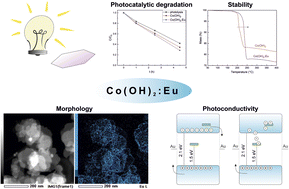
Transition metal hydroxides have been extensively used in the electrocatalytic oxygen evolution reaction; however, their use in photocatalytic processes remains less common. In this study, we report the successful synthesis of europium-doped (2.8 wt%) cobalt hydroxide nanoplates (Co(OH)2:Eu) via one-pot hydrothermal synthesis for photocatalytic and photoconductive applications. The structural and electronic properties of europium-doped cobalt hydroxide were studied and compared with undoped Co(OH)2 prepared via a similar procedure. Co(OH)2:Eu exhibited increased stability compared to undoped Co(OH)2. Potential applications of Co(OH)2:Eu for photocatalytic pollutant degradation were evaluated on the basis of methylene blue degradation. The band structure of Co(OH)2:Eu was proposed based on the photoconductivity behaviour. The mechanism of the driving forces of the photocatalytic degradation reaction was studied using band structure analysis and radical scavenger experiments. Furthermore, density functional theory (DFT) calculations provided a deeper understanding of the reason for the improved photocatalytic efficiency of Co(OH)2:Eu. We established that Co(OH)2:Eu possesses the local state above the conduction band edge, which induced a marked increase in the negative photoconductivity of Co(OH)2:Eu due to the binding of electrons, highlighting the potential use of rare-earth doping in optoelectronic switches.
 Please wait while we load your content...


