


 PLATFORM UPDATE:


Novel soluble sulfonyl-containing conjugated polymers as highly efficient photocatalysts for CO2 reduction reaction

Abstract
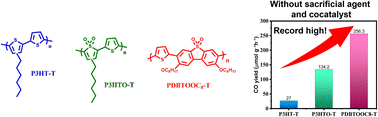
Solution-processable polymeric photocatalysts offer a promising advantage for photocatalytic CO2 reduction reaction (CO2 RR), including tunable optoelectronic properties, structural versatility, and scalable fabrication. In this work, we developed two sulfonyl-functionalized acceptor monomers, 2,5-dibromo-3-hexylthiophene 1,1-dioxide and 3,7-dibromo-2,8-bis(octyloxy)dibenzo[b,d]thiophene 5,5-dioxide, both incorporating long alkyl side chains to improve solubility and processability, and copolymerized them with 2,5-bis(trimethylstannyl)thiophene to build donor–acceptor (D–A) type conjugated polymers, P3HTO-T and PDBTOOC8-T. For comparison, a sulfonyl-free P3HT-T analogue was also synthesized. These resulting polymers were used as photocatalysts for CO2 RR under solar light, without needing a co-catalyst or sacrificial agents, demonstrating exclusive CO production with no detectable H2 evolution, thereby highlighting their high selectivity for CO2 RR. Incorporating the sulfonyl group in the P3HTO-T and PDBTOOC8-T polymer structures markedly enhanced the key charge dynamics, as evidenced by prolonged exciton lifetime from time-resolved photoluminescence, amplified current response in transient photocurrent measurements, and markedly reduced charge-transfer resistance observed by electrochemical impedance spectroscopy. Interestingly, PDBTOOC8-T achieved the highest CO yield of 256.3 µmol g−1 h−1, while P3HTO-T delivered 134.2 µmol g−1 h−1, both vastly outperforming the sulfonyl-free control polymer P3HT-T (27.0 µmol g−1 h−1). Both sulfonyl-functionalized polymers maintained steady catalytic performance over 24 h during photocatalytic CO2 RR. This work highlights a critical role of sulfone functionalization in enhancing the performance of polymer photocatalysts, offering a new pathway for designing efficient organocatalysts for CO2 RR.
 Please wait while we load your content...


