


Pressure-engineered migration bottlenecks and non-monotonic ionic conduction in NASICON solid electrolytes

Abstract
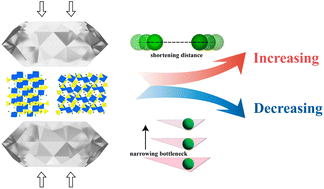
Solid electrolytes serve as critical components in all-solid-state batteries (ASSBs), where their ionic conductivity directly determines the overall electrochemical performance. Similar to temperature, pressure acts as an extrinsic control parameter that alters material properties via pressure-induced structural evolution. Herein, we report the pressure-dependent evolution of ionic conductivity and structural characteristics in NASICON solid electrolytes, focusing on two phases: the rhombohedral Na2.6Zr2Si1.6P1.4O12 and the monoclinic Na3Zr2Si2PO12. Notably, both compounds exhibit a non-monotonic pressure-dependent ionic conductivity, achieving distinct maxima at about 3.5 GPa for Na2.6Zr2Si1.6P1.4O12 and 2.9 GPa for Na3Zr2Si2PO12, followed by a progressive decline with increasing pressure. Under compression, in situ XRD data and Raman spectra confirm isostructural phase transitions in both compounds, while Raman spectra reveal the gradual amorphization. Further structural analysis reveals that applied pressure simultaneously shortens the distances between migrating Na+ ions (facilitating ion hopping) and narrows the bottleneck dimensions in the conduction pathway (increasing migration barriers). Since the bottleneck is one of the primary determinants for Na+ migration, these local structural modifications dictate the nonlinear conductivity variations. Our investigation elucidates the fundamental structure–property relationships in NASICON-structured solid electrolytes, providing critical insights for designing battery materials under extreme conditions.
 Please wait while we load your content...


