


 PLATFORM UPDATE:


Mechanistic insights into superionic conduction via homo-interface design for next generation semiconductor ionic fuel cells

Abstract
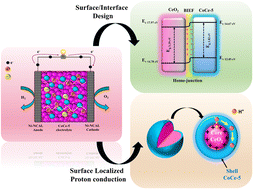
Semiconductor ionic materials (SIMs) are emerging as electrolytes for low-temperature fuel cells; however, conventional bulk doping strategies suffer from defect clustering, high ion migration barriers, and limited performance below 600 °C. Here, we report a homo-interface engineering strategy in cobalt-modified ceria, where controlled Co surface loading creates a core–shell structure within a single-phase fluorite lattice. This design generates a built-in electric field of 1.93 eV and oxygen-vacancy channels that enable superionic conduction with a reduced activation energy of 0.26 eV, nearly half that of undoped CeO2. The optimized CoCe-5 electrolyte exhibits ionic conductivity of 0.20 S cm−1 at 520 °C, delivering a peak power density of 1050 mW cm−2 with long-term stability over 160 h. In addition to its high performance, the material exhibited a significant enhancement in conductivity under electrochemical proton injection, confirming dynamic defect-assisted proton transport. Spectroscopic analyses and DFT calculations reveal bandgap narrowing (from 3.19 to 1.82 eV), reduction of Ce4+ to Ce3+, and electronic redistribution, which validate the interface-driven conduction mechanism. These findings establish homo-interface engineering as a paradigm shift from bulk doping to surface/interface design, offering a scalable route to create defect-rich, high-conductivity electrolytes. This work not only advances the design of SIM-based fuel cells but also provides a generalizable framework for next-generation electrochemical energy conversion technologies.
 Please wait while we load your content...


