


 PLATFORM UPDATE:


Hierarchical pore-engineered carbon cathodes for high-loading, lean-electrolyte lithium–sulfur cells

Abstract
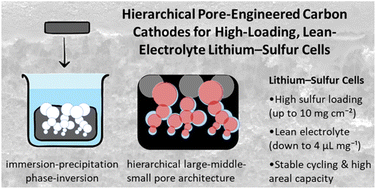
Achieving high-energy and durable lithium–sulfur cells remains hindered by polysulfide migration, active-material loss, and poor sulfur utilization under high-loading conditions. In this study, we introduce an immersion-precipitation phase-inversion strategy to construct carbon cathodes featuring a hierarchical large–middle–small pore architecture integrated with a dense conductive carbon network. This rationally engineered design ensures effective physical confinement of polysulfides, promotes rapid electron and ion transport, and imparts robust structural stability through the PVDF-HFP polymer backbone. The superior functionality of this cathode exhibits uniform sulfur distribution, effective polysulfide retention, and enhanced redox reversibility, while lean-electrolyte cells demonstrate low polarization, stable interfacial resistance, and high lithium-ion diffusion coefficients. As a result, lithium–sulfur cells employing the immersion-precipitation phase-inversion carbon cathode deliver high peak capacities of ∼1000 and 600 mAh g−1, with areal capacities exceeding 4 mAh cm−2. Systematic evaluations including high-rate operation (C/20–1 C rates), long-term cycling stability (200 cycles), high-loading operation (up to 10 mg cm−2), and lean-electrolyte testing (down to 4 μL mg−1) confirm the excellent material chemistry and cell-fabrication compatibility of this approach. Accordingly, this study presents a practical and generalizable cathode design that combines hierarchical porosity for suppressing polysulfide diffusion with conductive carbon frameworks that enable high-loading sulfur cathodes. The immersion-precipitation phase-inversion cathode achieves high energy density and stability, offering a practical and broadly applicable strategy for advancing next-generation lithium–sulfur batteries.
 Please wait while we load your content...


