


Defect-engineered VOx cathode and novel polyvinyl alcohol@polyaniline hydrogel separator for ultra-stable fiber Zn-ion batteries
 *a
Pibin
Bing
*a
and
*a
Pibin
Bing
*a
and
Abstract
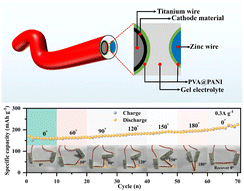
Flexible fiber zinc-ion batteries (FZIBs) have shown enormous potential in portable electronic devices owing to their excellent safety, flexibility and biocompatibility; however, their specific capacity and cycling stability are severely constrained by their cathodes and separator. Herein, a facile annealing method is employed to incorporate nitrogen atoms and oxygen vacancies into the structure of VOx (referred to as VO@450) to improve its conductivity and stability. Specifically, nitrogen doping and the integration of oxygen vacancies accelerate the diffusion of Zn2+ and the formation of a high ratio of V5+, thereby improving the specific capacity and stabilizing the structure of VOx. As a result, the optimal VO@450 electrode demonstrates an outstanding performance with 571.6 mA h g−1 at 0.1 A g−1, 223.3 mA h g−1 at 8 A g−1, and excellent stability over 2000 cycles at 4 A g−1. Subsequently, FZIBs were successfully assembled using VO@450 as the cathode and a novel polyvinyl alcohol (PVA)@polyaniline (PANI) hydrogel polymer separator, achieving a high specific capacity of 216.5 mA h g−1 at 0.5 A g−1 over 200 cycles and maintained a high capacity retention of 81% over 1200 cycles at 1 A g−1, with high flexibility. This study introduces a novel strategy for optimizing the structure of the cathode and porous separator for high-performance fiber zinc ion batteries.
 Please wait while we load your content...


