


 PLATFORM UPDATE:


Magnesium chloride salt-assisted synthesis of porous N-doped carbons from molten polycyclic aromatic hydrocarbons for high-performance supercapacitors
 a
Alagar Raja
Kottaichamy,
*abc
Michael
Volokh,
a
Rotem
Geva,
a
Alexander
Upcher,
d
Jonathan
Tzadikov,
*a
Jesús
Barrio
e
and
Menny
Shalom
*ad
a
Alagar Raja
Kottaichamy,
*abc
Michael
Volokh,
a
Rotem
Geva,
a
Alexander
Upcher,
d
Jonathan
Tzadikov,
*a
Jesús
Barrio
e
and
Menny
Shalom
*ad
Abstract
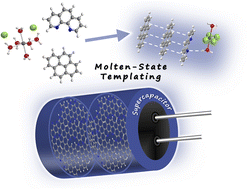
Supercapacitors are essential for energy storage applications requiring high power density and long-term cycling stability. This study presents a scalable molten-state approach for synthesizing high-performance nitrogen-doped carbons (NdCs), leveraging magnesium chloride hexahydrate as both a templating agent and a stabilizing medium. The molten-state process facilitates hydrogen bonding between the magnesium complex and phenanthroline's nitrogen atoms, enabling controlled self-assembly. Systematic variation of the starting monomer ratios allows precise control over specific surface area, porosity, and hydrophilicity. The optimized composition achieves high electrochemical properties with a specific surface area of 1400 m2 g−1, enhanced hydrophilicity, and state-of-the-art specific capacitance of 818 F g−1 at 1 A g−1. The optimized material demonstrates outstanding rate capability, maintaining 98% capacitance retention after 20 000 cycles. When implemented in an asymmetric two-electrode supercapacitor device, it delivers an energy density of 31 W h kg−1 at a power density of 267 W kg−1, outperforming commercial activated carbon. The enhanced performance stems from synergistic effects of magnesium-mediated structural defects, optimal nitrogen doping, and improved electrolyte accessibility. This work advances the rational design of carbon-based electrode materials for next-generation energy storage applications.
 Please wait while we load your content...


