


 PLATFORM UPDATE:

Surface-tension-free fabrication to minimize defects in cobalt-silica membranes via the freeze-drying technique for H2 separation at high temperatures

Abstract
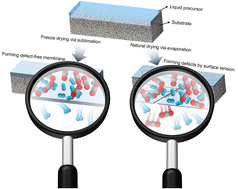
Hydrogen is a promising substitute for fossil fuels because it has a high calorific value and is eco-friendly. Cobalt-doped silica membranes, suitable for separating hydrogen from other larger molecular gases at high temperatures, are commonly fabricated by the dip-coating method, followed by evaporation drying and calcination. However, these membranes suffer from defects within selective layers, reducing the separation efficiency by allowing non-selective permeation. These defects can be ascribed to surface tension effects during evaporation drying, where the imbalance between liquid-phase cohesion and adhesive interactions with the solid substrate leads to non-uniform solvent evaporation, resulting in stress accumulation, capillary forces, and eventual structural imperfections such as cracks and pinholes. In this study, a novel freeze-drying technique is introduced to minimize defects in cobalt-silica membranes by avoiding surface tension. For this purpose, α-alumina substrates were selected, and a zeolite interlayer was formed on the substrate, which provided the pore size transition to fabricate cobalt-doped silica separation membranes. The structural and morphological analyses confirm the effectiveness of the freeze-drying technique, revealing a higher silica condensation, increased amorphous character, smoother surfaces, homogeneous cobalt dispersion with the presence of Co3+, and uniform, smaller pore sizes, outperforming the evaporation-dried technique in terms of separation efficiency and indicating fewer defects. At 500 °C, the freeze-dried membrane showed almost three times higher H2/N2 and H2/CO2 selectivity than the conventional evaporation-dried membrane. The novel freeze-drying technique showed a promising potential for H2 separation applications at high temperatures.
 Please wait while we load your content...


