


 PLATFORM UPDATE:


Tailoring optical and ferroelectric properties in Sb1−xBixSI van der Waals chalcohalides towards solar absorber applications

Abstract
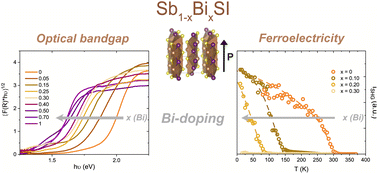
The efficiency of solar cells depends on absorber materials whose optical and electronic properties can be precisely tuned for optimal performance. The mixed-anion, van der Waals material SbSI is a promising candidate, offering both a narrow bandgap and strong ferroelectric polarization, which together produce a robust bulk photovoltaic effect and high power conversion efficiency (PCE). Here, we demonstrate that substituting bismuth for antimony in SbSI enables controlled tuning of both the bandgap and ferroelectric properties. Increasing Bi content induces anisotropic changes in the crystal structure, with the bandgap decreasing rapidly at low substitution levels and stabilizing at 1.5 eV for higher Bi concentrations. Concurrently, ferroelectricity is strongly suppressed, as evidenced by the disappearance of soft-phonon modes and second-harmonic generation signals. First-principles calculations support the observation that the ferroelectric ground state becomes unfavorable with Bi substitution, driven by changes in Sb/Bi–S bonding characteristics and a concomitant reduction in the lone-pair expression. This ability to finely tune both structural and functional properties highlights the potential of Sb1−xBixSI for the development of high-performance, next-generation solar-energy materials.
 Please wait while we load your content...


