


 PLATFORM UPDATE:


Gas evolution in Ruddlesden–Popper-type intercalation cathodes in all-solid-state fluoride-ion-batteries: implications on battery performance and synthesis of highly oxidized oxyfluorides

Abstract
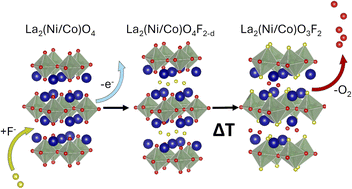
In this work, we report the gas evolution behavior of two common intercalation-based cathode materials for fluoride-ion-batteries (La2NiO4 and La2CoO4) by chemical fluorination and electrochemical fluorination, as well as the thermal stability of the electrochemically fluorinated active materials. Variable-temperature X-ray diffraction with coupled mass spectrometry shows that the fluorinated phases of both active materials release oxygen after oxidative fluorination using AgF. Differential electrochemical mass spectrometry revealed that significant CO2, CO and NO evolution takes place during electrochemical fluorination, but O2 evolution could not be detected. Consequently, the gas evolution observed does not compromise the long-term stability of the cell performance. Variable-temperature X-ray diffraction of the charged cathode composites reveals that the electrochemically fluorinated products decompose once heated beyond 300 °C, and then undergo similar phase evolution behavior as observed in chemical fluorination. Thus, we conclude that oxygen evolution in RP-type materials on oxidative fluorination requires thermal activation beyond the operational temperature of 170 °C, and that it can be kinetically suppressed regardless of the reduced Fermi level induced on fluorination. Our findings indicate that concepts used for the oxidative topochemical fluorination of materials need to be reconsidered: the choice of fluorination conditions must be carefully adopted to the changes of electronic structure induced and the temperature dependence of the oxygen evolution of the highly oxidized state.
 Please wait while we load your content...


