


 PLATFORM UPDATE:


Unlocking liquid chemisorption in solid matrices: immobilized deep eutectic solvent-ZIF-8 composites for next-generation CO2 capture
 a
Xiaoliang
Wang,
a
Haomiao
Xie,
a
Kent O.
Kirlikovali,
a
Justin M.
Notestein,
b
Edward H.
Sargent
ae
and
Omar K.
Farha
*abcd
a
Xiaoliang
Wang,
a
Haomiao
Xie,
a
Kent O.
Kirlikovali,
a
Justin M.
Notestein,
b
Edward H.
Sargent
ae
and
Omar K.
Farha
*abcd
Abstract
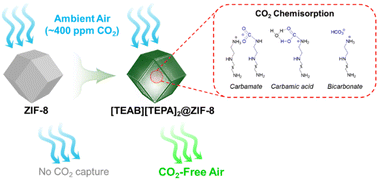
Achieving net-zero emissions by 2050 requires scalable and durable CO2 capture solutions, with direct air capture (DAC) gaining increasing prominence. Deep eutectic solvents (DESs) have emerged as promising candidates due to their strong chemisorptive properties, but their liquid-phase nature limits integration into solid systems. In this study, we introduce a solid–liquid hybrid approach by immobilizing [TEAB][TEPA]2, a highly CO2-reactive DES, onto various supports via non-covalent immobilization. This strategy induces solid-like behavior while retaining molecular-level reactivity of the DES. Among the supports including ZIF-8, zeolite Y, zirconia, and alumina, the [TEAB][TEPA]2@ZIF-8-56% composite demonstrated promising CO2 uptake capacity of 2.00 mmol g−1 adsorbent at 1 bar, 1.48 at 0.15 bar, 0.96 at 0.01 bar, and 0.59 at 0.4 mbar. Particularly, we can observe that the chemisorption capacity under 400 ppm conditions is successfully introduced into ZIF-8, whereas pristine ZIF-8 showed negligible uptake under these same conditions. Breakthrough experiments confirmed robust capture behavior under humid conditions. The composite exhibited excellent cycling stability over 100 capture-release cycles, supported by thermogravimetric analysis. In situ DRIFTS verified that the chemisorptive nature of the DES remained intact after immobilization. Additional characterization studies, including FTIR, PXRD, N2 physisorption, and XPS depth profiling, revealed partial DES infiltration and strong interfacial interactions. Comparative results using alumina-based composites underscored the importance of microporosity in stability. These findings suggest that DES-MOF composites hold promise as carbon capture materials, bridging liquid-phase functionality and solid-state robustness.
 Please wait while we load your content...


